Homeowner’s Guide to Mobile Home Demolition & Removal
Old mobile home to remove? Learn the real costs, permits, demolition steps, and disposal options so you can clear your property safely and legally.
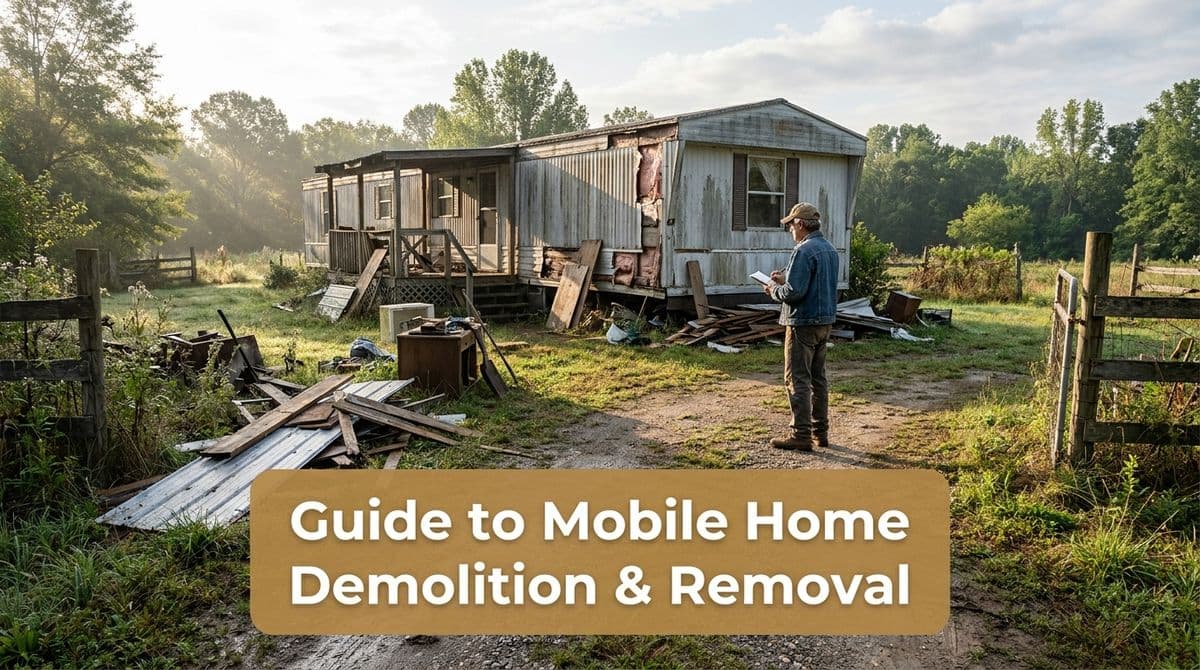
“Can You Demo Our Old Mobile Home and Haul It Off?”
We recently got a call from a homeowner — we’ll call her Lisa — who had an old, dilapidated mobile home on her property. It was one of those older single-wides, about 14' x 52', and it had seen better days. The roof was soft, the interior was shot, and it wasn’t worth repairing.
Lisa’s question was simple: “Can you demolish it and haul it off — and what does that involve?” That’s exactly the kind of project we handle, so our first response was: “If it’s good with you, we’d like to come out today, put some eyes on it, get measurements, and figure out how many cubic yards of debris we’re looking at.”
That quick site visit is where every safe mobile home demolition should start, and it led to a lot of good questions that other homeowners have too.
Step 1: Walkthrough and Planning the Demolition
When we met Lisa on-site in Angleton, we started with a walkthrough to check:
- Size and layout – length, width, and whether there were additions like porches or decks.
- Condition – how unstable the frame, roof, and floors were.
- Access – driveway space, low-hanging wires, trees, or tight gates for trucks and equipment.
We also looked at the steel frame under the home. In Lisa’s case, the frame was in decent shape, which meant it could be cut up for scrap metal and help offset some disposal costs.
From that visit, we were able to estimate how many cubic yards of debris we’d be hauling, which is a big factor in both cost and what equipment we’d bring.
Permits, Utilities, and Safety Checks
Before anything comes down, we always talk about paperwork and safety. Every city and county is a little different, but most require:
- Demolition permit for removing a structure.
- Utility disconnects from power, water, sewer/septic, and gas/propane.
We recommend homeowners call their utility providers to verify everything is properly disconnected and capped. In some areas, proof of disconnect is required before a permit is issued.
Many homeowners ask, “Can we just start tearing it down?” Our answer is always no until:
- Permits are in place (if required).
- Utilities are safely disconnected.
- We’ve checked for hazardous materials like asbestos or old fuel tanks, if applicable.
Demolition Options: Tear-Down vs. Deconstruction
Once everything is cleared and safe, there are two main ways to remove an old mobile home:
1. Mechanical Demolition
This is what most people picture: using equipment (like an excavator or skid steer) to carefully tear the structure apart and load it into dump trailers. It’s:
- Faster than hand deconstruction.
- Usually the most cost-effective option.
- Best for homes that are too far gone to salvage much.
2. Partial Deconstruction and Salvage
With some mobile homes, it can make sense to remove certain items by hand before bringing in equipment, such as:
- Metal siding and roofing
- AC units and appliances
- Steel frame sections (for scrap)
This approach can slightly reduce landfill volume and give you a bit of value back in scrap or reusable materials, but it adds some labor, so it’s not right for every project.
Cost: What Homeowners Like Lisa Can Expect
Every homeowner wants to know, “What’s this going to cost?” While we don’t post fixed prices online because each job is different, we walk customers through the main cost drivers during the site visit:
- Size of the home – A 14' x 52' single-wide like Lisa’s costs less than a double-wide or a home with large porches and additions.
- Condition – A severely rotted or collapsed home may take more careful work and time.
- Haul-off volume – More cubic yards of debris means more loads to the landfill or recycling center.
- Disposal fees – Landfill rates and any specialty disposal (like tires or certain appliances) in your area.
- Access – Tight or difficult access can add time and sometimes require smaller equipment.
We provide a written estimate so you know exactly what’s included: demolition, haul-off, disposal fees, and basic site cleanup.
Disposal and Recycling: Where Everything Goes
Homeowners are often surprised at how many different disposal streams are involved. For Lisa’s project, we talked through:
- Steel frame and other metals – Cut up and sent to a scrap yard.
- Wood, drywall, and insulation – Hauled to an approved construction and demolition landfill.
- Appliances and AC units – Handled separately so refrigerants and electronics are properly managed.
We load and separate as we go whenever it makes sense, to keep the job efficient and as environmentally responsible as local facilities allow.
What Your Property Looks Like Afterward
At the end of a demolition, we don’t just leave a pile of debris. A standard mobile home removal usually includes:
- Removing the home and loose debris
- Pulling obvious trash and broken materials
- Rough grading the area where practical so it’s reasonably level
If you’re planning to install a new home, build, or add a shop, we can also talk about additional grading or pad prep as a separate step.
How to Get Started on Your Own Mobile Home Demo
If you’re staring at an old mobile home and wondering what to do, here’s a simple way to move forward:
- Confirm ownership and title so there are no surprises.
- Call your local city or county to ask about demolition permits and requirements.
- Schedule a site visit with a demolition and haul-off contractor.
- Arrange utility disconnects and keep documentation.
- Review a written estimate that clearly lists demolition, haul-off, and cleanup.
That’s exactly the path we walked through with Lisa. We came out, took measurements, estimated the cubic yards, discussed scrap value on the frame, and put together a clear plan and timeline so she knew what to expect from start to finish.
If you’re in a similar situation with an old mobile home you’re ready to remove, the safest and simplest next step is to bring in a team that does this kind of work every day and can guide you through permits, demolition, and disposal the right way.